Quality & Safety
Quality isn't a badge. It's a process you can check.
Most peptide sites show you a "99% pure" sticker and ask you to trust it. We'd rather show you the work: where the material comes from, how it's made, how it's tested, and — just as importantly — what those tests do and don't prove.
If you're sourcing for serious work, the documentation matters as much as the compound. Here's ours.
All Caliber products are sold for laboratory and research use only. Nothing on this page is a medical or therapeutic claim.
At a glance
- We vet the manufacturer — facility, water and sterility controls — before sourcing a single vial.
- Pharmaceutical-grade GMP Grade A (Class 100) aseptic filling.
- Bacteriostatic water made to Water-For-Injection standard — distillation removes endotoxins.
- Every order ships with a batch Certificate of Analysis: HPLC purity + mass-spec identity.
- We are straight about what testing does, and does not, prove.
- Sold for research use only.
We vet the manufacturer, not just the product
The single biggest variable in this market is who actually makes the material. Anyone can resell a white powder. The question is whether the source behind it runs a real, controlled operation — or a back room.
Before we sourced a single vial, we ran due diligence on our manufacturing partner: their facility standards, their water and sterility controls, their batch testing, their documentation, and their consistency across compounds. We source from an established manufacturer in China that supplies the wider research-compound market — and whose material is, as a result, widely and independently tested across the research community. That external scrutiny is part of why we chose them.
We don't pretend any source is flawless on every batch. That's exactly why testing and documentation exist — and why we don't hide behind a sticker.
The manufacturing standard
Our partner produces to a pharmaceutical-grade standard. The same controlled line is used for the bacteriostatic water and for the aseptic filling of the peptide vials. In plain terms, this is what that involves:
Vials are washed and heat-sterilised, then filled and sealed in a certified clean environment — the same cleanliness classification used for sterile pharmaceutical filling.
Every unit is machine-vision inspected for particulates, glass fragments and seal defects. Failures are rejected.
Every batch is checked against pharmacopoeia parameters before release — sterility, pyrogens, pH and conductivity.
This is the infrastructure most resellers never see and can't describe. We can, because we asked.
The water: pharmaceutical Water-For-Injection
The bacteriostatic water you reconstitute with is produced to Water-For-Injection (WFI) standard — the highest grade of water used in injectable pharmaceutical manufacturing. The process is built specifically to remove the two things that matter most: dissolved contaminants and bacterial endotoxins.
- 1Raw water pre-treatment
Multi-media filtration removes sediment and particulates; activated carbon strips residual chlorine, odours and organics; ion-exchange softening prevents scale.
- 2Purified water
Two-pass reverse osmosis removes the bulk of dissolved salts, colloids and microorganisms; electrodeionisation (EDI) deep-desalinates to purified-water standard.
- 3Water-For-Injection (WFI)
Multi-effect distillation is the core endotoxin-removal step. Because endotoxins are non-volatile and have a very high boiling point, they are left behind in the concentrate — only pyrogen-free, ultra-pure steam condenses into WFI. The water is then held above 80°C in continuous circulation to prevent any microbial growth.
- 4Terminal sterilisation
Sealed product undergoes terminal moist-heat sterilisation (autoclave, 121°C for 15–30 minutes), destroying microorganisms and spores.
- 5Full-panel batch testing
Sterility, pyrogen, pH and conductivity — to pharmacopoeia compliance — before anything is released.
raw water pre-treatment → purified water → Water-For-Injection → storage & distribution → sterilisation → aseptic filling → full-panel testing → finished product
How research peptides are tested — and what each test tells you
There's an established testing vocabulary in this field. Here's what the terms mean, so you can read any vendor's documentation (not just ours) and know what you're looking at.
High-Performance Liquid Chromatography separates the sample and measures what percentage is the target compound versus related impurities. 98%+ is generally considered research grade; 95–98% is acceptable for many applications; below 95% warrants caution. It tells you how clean — not what it is.
Confirms the compound is actually what it claims to be, by matching the measured molecular weight against the theoretical weight for that sequence. HPLC and MS together give you both purity and identity — you need both.
How much active peptide is in the vial versus water and salts. A compound can be 99% pure but 80% net content. Relevant when precise concentrations matter.
Detects bacterial endotoxins, which standard sterilisation does not destroy. This is why the WFI distillation step above matters.
Confirms no viable microbial growth.
Screens for lead, cadmium, arsenic and mercury — contaminants invisible to HPLC and MS.
Every order ships with a Certificate of Analysis from the manufacturer's QC lab showing HPLC purity and mass-spec identity for the compound, alongside the per-batch sterility, pyrogen, pH and conductivity testing built into the manufacturing process described above.
How to read a Certificate of Analysis
A CoA turns an unlabelled powder into a verifiable reagent. When you get one — from us or anyone — check four things:
- 1.Compound & batch — does the batch number on the CoA match the vial?
- 2.HPLC purity — the percentage, ideally with the chromatogram. The main peak should dominate.
- 3.Mass-spec identity — observed molecular weight should match the theoretical weight for the stated sequence.
- 4.Date & source — a recent CoA tied to the actual batch, not a generic sample from a year ago.
If a vendor can't produce a batch-specific CoA, that tells you something.
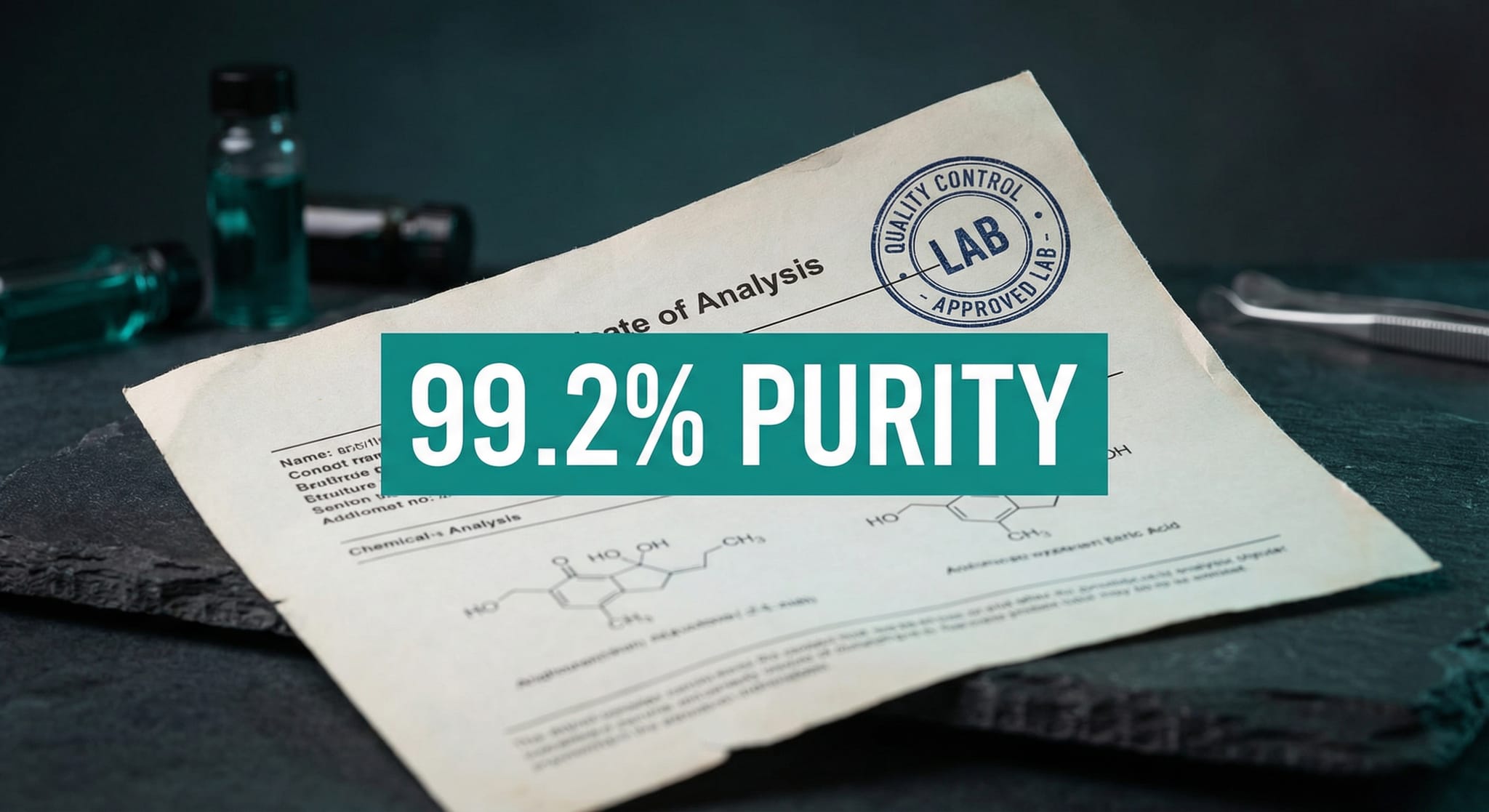
Every order ships with the Certificate of Analysis for its batch. Want to see one before you order? Ask us for the CoA on any compound and we'll send it across.
Request a CoA on WhatsAppWhat testing does — and doesn't — prove
We'd rather you trust us because we're straight with you than because we oversold. So, plainly:
That honesty is the point. A vendor who tells you only the good half of the story is the one to be careful with.
Research use only
All Caliber products are sold strictly for laboratory and research use. They are not approved for human or veterinary use, consumption, or any therapeutic, diagnostic or cosmetic application. Nothing on this page constitutes a medical claim. By ordering, you confirm you are acquiring these materials for lawful research purposes only.